Study Shows Venus’s Lower Haze Consists of Cosmic Dust
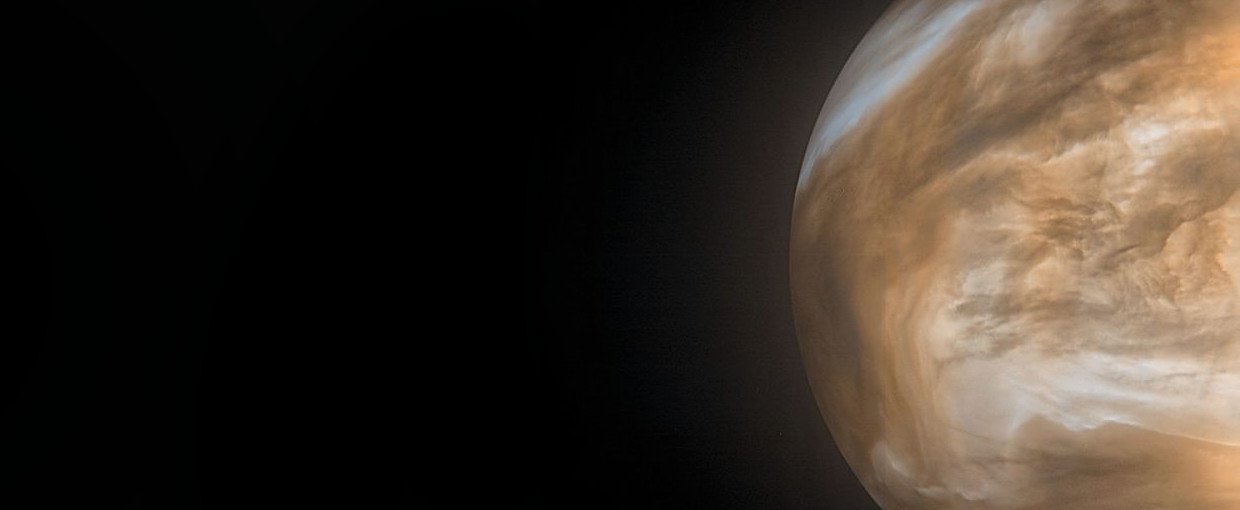
Recent re-examination of measurements taken by the 1970s Venera landers and Pioneer Venus orbiter indicates that Venus's distinctive yellowish "lower haze" consists mainly of fine interplanetary dust instead of a special atmospheric aerosol.
When the Soviet Venera probes and NASA's Pioneer Venus spacecraft initially photographed Venus, they observed a steady, faintly illuminated stratum close to the bottom of the cloud deck. Researchers then could only hypothesize about its composition, calling it a puzzling haze that set Venus apart from other rocky planets.
By applying contemporary spectroscopic methods to the original probe data, scientists have pinpointed the haze particles as sub-micron silicate grains identical to the interplanetary dust that continuously traverses the inner solar system. Matching the probes' wavelength-dependent scattering patterns with laboratory spectra of known dust types allowed the team to dismiss sulfuric-acid droplets as the primary constituent.
Venus's powerful gravity and dense atmosphere make it capable of seizing such extraterrestrial particles, which on Earth would typically incinerate at higher altitudes. After capture, the dust descends into the lower cloud zone and stays aloft thanks to turbulent winds, producing the subtle yellow hue recorded by the pioneering missions.
Recognizing that the lower haze is predominantly dust carries immediate consequences for atmospheric models. Dust interacts with radiation in a way that differs from sulfuric-acid aerosols, altering the absorption and re-emission of sunlight. Consequently, predictions of surface temperature and the behavior of Venus's super-rotating winds become more precise.
This discovery also changes the perspective on material exchange among planets. Once thought of as an isolated extreme, Venus now seems to engage in the solar system's wider dust cycle, a mechanism that could be echoed on other planets possessing thick atmospheres.
Upcoming missions—including NASA's VERITAS and DAVINCI+ and ESA's EnVision—plan to bring sophisticated spectrometers that can directly probe the lower cloud layer. Their data will further evaluate the dust hypothesis and may uncover how incoming interplanetary material interacts with Venus's distinctive chemistry.

Comments (0)
Be the first to comment.
Join the discussion