Wednesday Evening Brings Partial Solar Eclipse; Experts Urge Strict Eye Safety
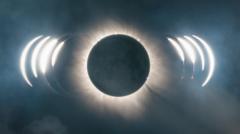
This Wednesday evening, a partial solar eclipse will offer a captivating sight for observers in specific areas. Though it won't completely obscure the sun, this rare celestial occurrence has prompted specialists to highlight the paramount need for secure viewing methods for all who wish to observe it.
When the Moon travels between our planet and the Sun, but only partially obstructs the solar disc, a partial solar eclipse takes place. From Earth's perspective, it will seem as though a segment has been removed from the Sun. As this specific event is set for Wednesday evening, individuals planning to view it must remain informed about their local sunset times and atmospheric conditions.
Safeguarding one's vision constitutes the foremost priority when experiencing any solar eclipse, whether partial or total. Gazing directly at the sun, even momentarily, risks irreversible optical harm, such as solar retinopathy, which can manifest as impaired vision or total sight loss. The sun's intense radiation poses a threat even when the moon partially obscures it.
To ensure a safe observation of the partial eclipse, dedicated solar filters are indispensable. These encompass certified solar eclipse glasses conforming to the ISO 12312-2 international safety standard, or specialized solar filters intended for use with telescopes and binoculars. An additional secure and easily implemented technique involves constructing a pinhole projector, enabling observers to cast an image of the sun onto a surface without direct viewing. It is absolutely vital to understand that standard sunglasses, improvised filters, or smoked glass offer inadequate protection and are hazardous.
Although a partial eclipse may not deliver the profound darkness associated with a total eclipse, it nonetheless represents a captivating astronomical phenomenon, illustrating the complex interplay of celestial bodies within our solar system. This presents an occasion for individuals across all age groups to engage with the cosmos, provided they rigorously follow established safety protocols.
Prospective observers are encouraged to consult websites of local astronomical societies or trustworthy science news sources for accurate start and end times relevant to their location. Even a minimal portion of the sun's surface possesses the capacity to inflict damage, thereby rendering thorough preparation for secure viewing absolutely essential.
With Wednesday evening drawing near, the collective message from scientific and medical experts is unequivocal: relish the awe-inspiring natural spectacle of the partial solar eclipse, yet place eye protection as your utmost priority to avert permanent injury.


Comments (0)
Be the first to comment.
Join the discussion