New Research Indicates Martian Gullies Formed by CO₂ Frost Rather Than Water
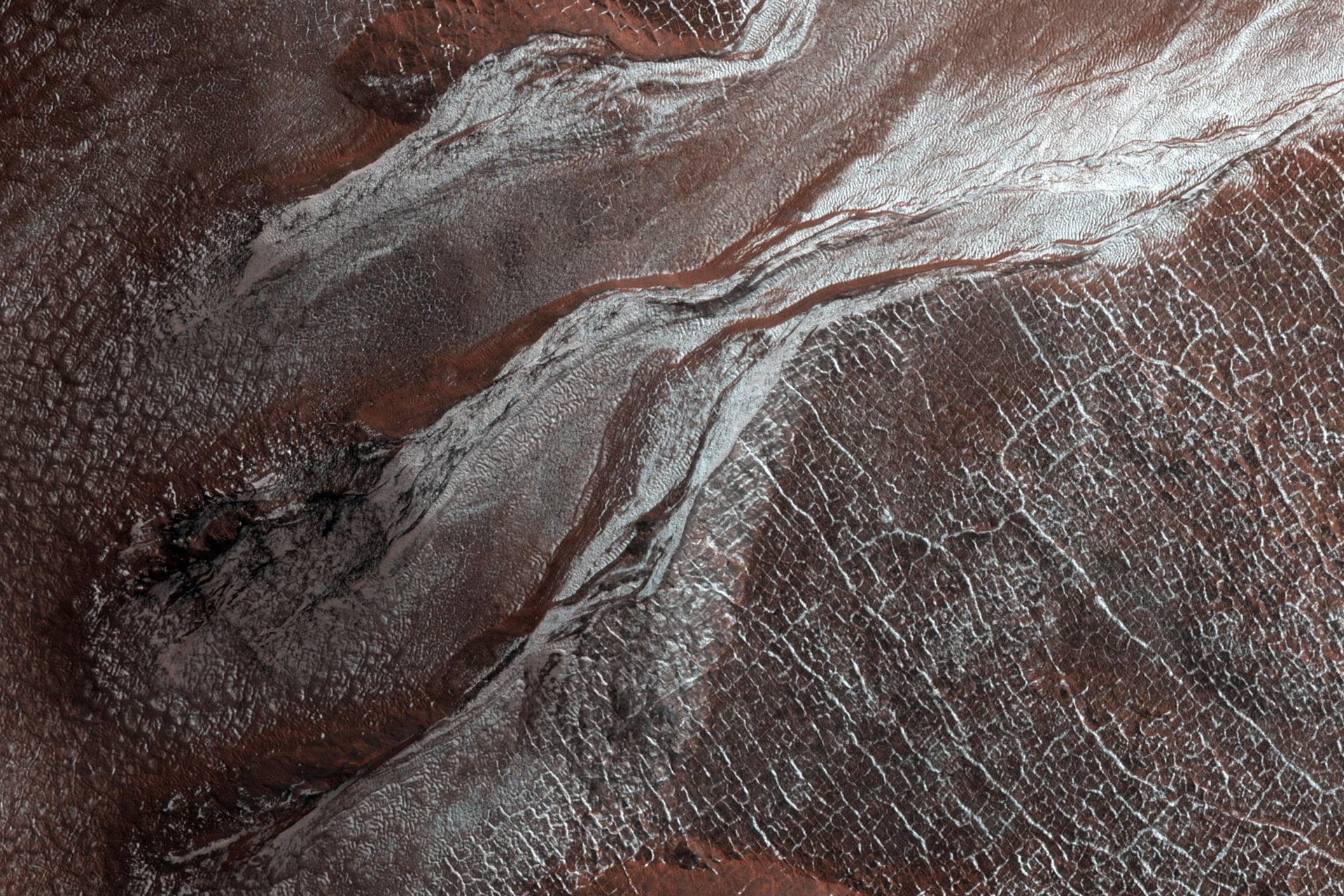
A fresh examination of high‑resolution images now disputes the decades‑old notion that the diminutive valleys and channels lining Martian slopes were sculpted by liquid water, suggesting instead that seasonal carbon‑dioxide frost serves as the main agent.
First recorded by orbiting probes in the early 2000s, the gullies generated enthusiasm since their geometry—slim cuts topped by alcove‑like heads and terminating in fan‑shaped deposits—resembled terrestrial water‑carved forms, prompting many to interpret them as signs of recent moisture.
Planetary scientists revisited the structures with the HiRISE camera on the Mars Reconnaissance Orbiter, capable of resolving features down to 30 cm per pixel. Their analysis of images spanning several Martian years showed fresh deposits emerging in winter—when temperatures permit carbon‑dioxide frost to build up—and disappearing in spring as the frost sublimates.
Such a seasonal cycle matches the dynamics of CO₂ ice rather than any thermal range that would allow liquid water. Laboratory experiments and climate models back the concept that thin CO₂ frost layers may destabilize, cascade downslope, and drag loose regolith, etching channels that closely mimic those once thought to be water‑formed.
Geographically, numerous active gullies occupy pole‑ward‑facing slopes that get scant sunlight, rendering them ideal for preserving frost. The authors contend that this distribution bolsters a frost‑centric formation model, while noting that ancient, now‑dormant gullies could have arisen under distinct, perhaps wetter, circumstances.
Although the research lowers the chances that present‑day liquid water sculpted these formations, it does not rule out a historically wetter Martian environment. The findings underscore the importance of time‑series, high‑resolution imaging for unraveling planetary geology and propose that upcoming missions with ground‑penetrating radar or on‑site sampling could better determine if subsurface ice played a role in the ancient gullies.


Comments (0)
Be the first to comment.
Join the discussion