Astronaut's Orbital Snapshot Reveals Sahara's 'Skull' Volcano and Ancient Lava Trails
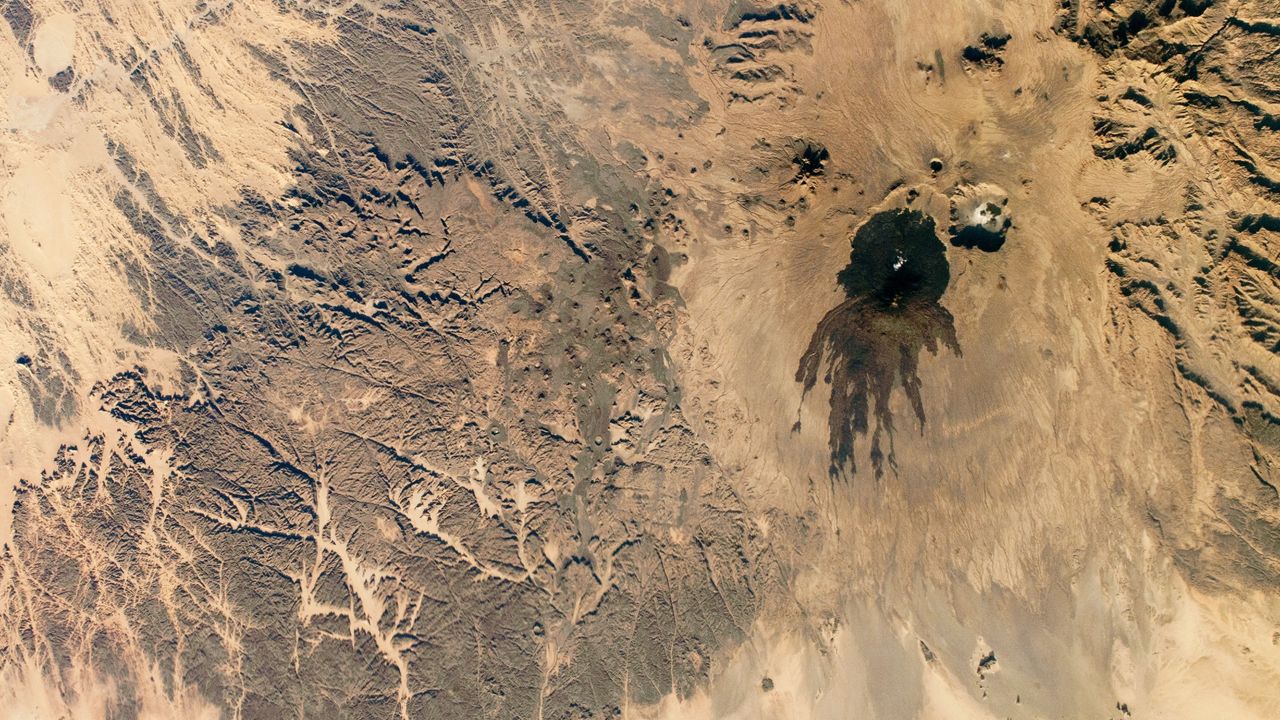
On September 23, 2019, an astronaut aboard the International Space Station took a remarkable photo, showcasing Chad's Toussidé volcano. This image provides an extraordinary insight into Earth's geological past, drawing attention to its unique ancient lava flows and a caldera that, when viewed from space, strongly evokes the shape of a skull.
Toussidé, an active stratovolcano, stands out as a major landmark within the Tibesti Mountains, a harsh mountain range located deep within the Sahara Desert. Recognized as one of Africa's most sizable volcanoes, its vast caldera and many previous lava eruptions serve as evidence of a lengthy and potent geological timeline, which has sculpted the surrounding dry terrain.
The photograph taken by the astronaut distinctly highlights the fossilized traces of these ancient lava streams, visible as dark, pronounced marks etched across the volcanic landscape. Next to these flows, the volcano's caldera takes on a unique, skull-like appearance, generating a striking visual difference against the desert's paler shades. This characteristic underlines the vast, persistent energies that have molded our planet's topography for thousands of years.
Data collected from the International Space Station offers crucial insights across numerous scientific fields. Specifically, images captured by astronauts enhance automated satellite pictures by presenting singular, often artfully arranged, perspectives capable of focusing interest on particular geological formations, shifts in the environment, or atmospheric events in captivating manners.
Given its isolated and demanding landscape, the Tibesti Mountains area frequently proves challenging to investigate thoroughly from the surface. Consequently, orbital photographs, like this one of Toussidé, are vital in assisting researchers to grasp the enduring trends of volcanic behavior, the mechanisms of erosion, and the distinct ecological attributes of this immense desert territory.
The discernible ancient lava flows act as a historical timeline of Toussidé's previous eruptions, demonstrating the volcano's developmental stages and its part in the geological progression of the area. Even when inactive, volcanic terrains are perpetually molded by natural elements, resulting in striking and frequently breathtaking geological structures.
In conclusion, such photographs do more than merely aid scientific inquiry; they also offer a potent visual confirmation of the Earth's surface's energetic and often stunning splendor. These views from orbit assist in cultivating a deeper understanding of our planet's intricate geological activities and its constantly evolving natural marvels, observed by those circling overhead.


Comments (0)
Be the first to comment.
Join the discussion